Skip to content
United States

$20 Double Eagle: Liberty and Saint-Gaudens

United States · 1850-1933 · Gold

Written by the Maison Or & Bijoux Strasbourg team · updated

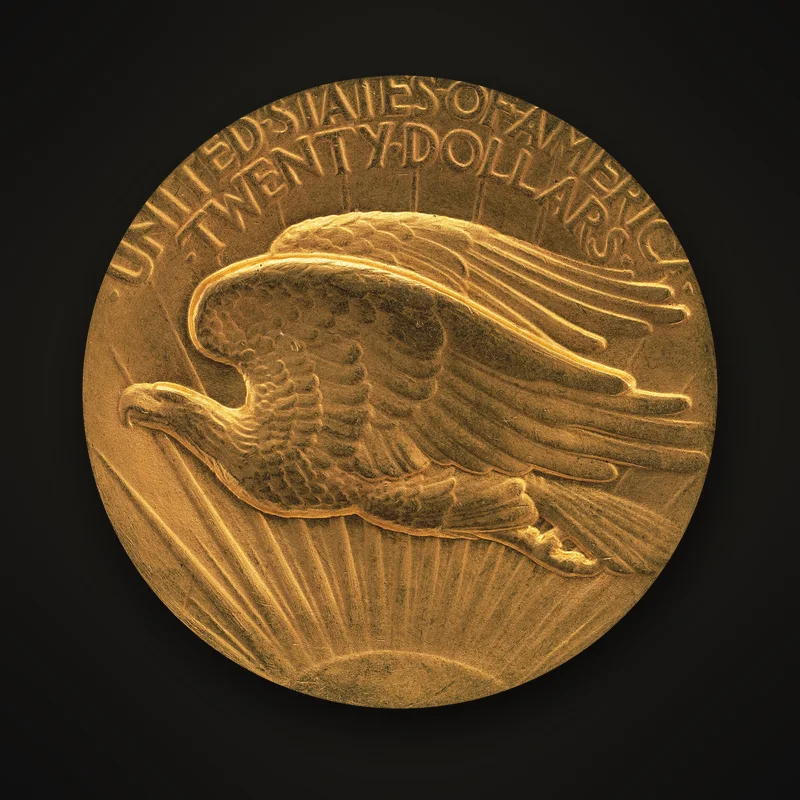
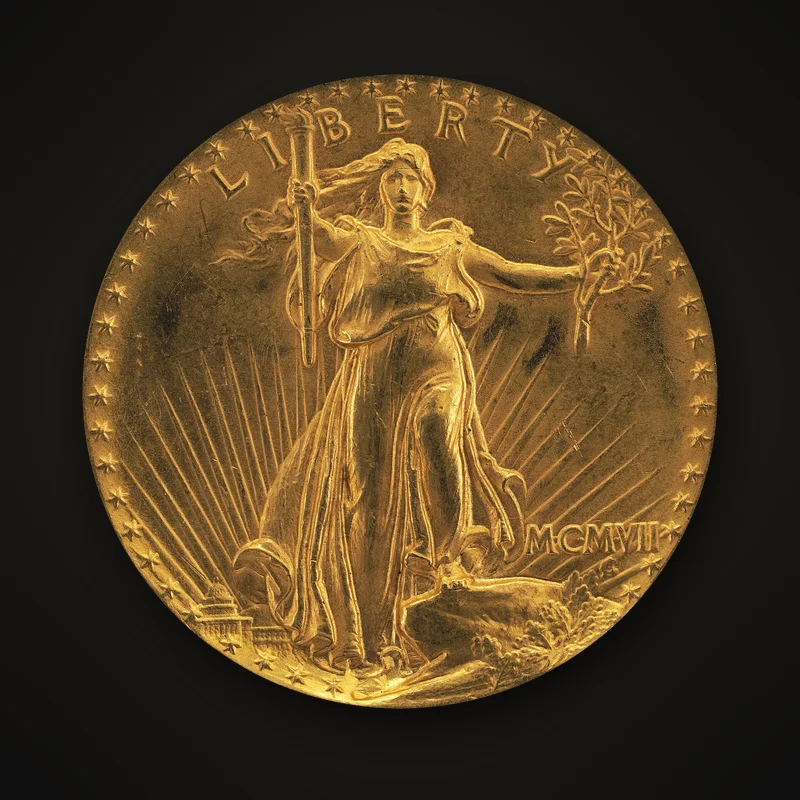
1907 Saint-Gaudens high relief $20 gold coin, obverse: Liberty striding forward with a torch and olive branch, in front of the sun and the Capitol1907 Saint-Gaudens $20 gold coin, reverse: eagle in flight above a rising sun
Photos: National Gallery of Art, CC0, via Wikimedia Commons, cut out on a black background.
Specifications
CountryUnited States
MetalGold, 900‰ fine (10% copper)
Weight33.44 g
Fine gold30.09 g
Diameter34 mm (34.1 mm according to some sources)
Years struckLiberty: 1850-1907 (pattern in 1849); Saint-Gaudens: 1907-1933
MintsPhiladelphia (no mark), New Orleans (O), San Francisco (S), Carson City (CC), Denver (D, from 1906)
EngraverJames B. Longacre (Liberty); Augustus Saint-Gaudens (Saint-Gaudens)
EdgeReeded (Liberty); raised “E PLURIBUS UNUM” (Saint-Gaudens)
ReferencesAmerican catalogues by date and mint (Red Book, PCGS numbers)

The $20 gold coin, or “double eagle”, is the largest gold circulation coin of the United States: 33.44 g, struck from 1850 to 1933. Two types followed one another: the crowned head of Liberty (Liberty, 1850-1907), then the full-length Liberty in front of the sun (Saint-Gaudens, 1907-1933). Millions of coins were shipped to European banks, which explains why they are still found in France.

Identification

$20 Double Eagle: Liberty and Saint-Gaudens: how to recognise it

1907 Saint-Gaudens high relief $20 gold coin, obverse: Liberty striding forward with a torch and olive branch, in front of the sun and the Capitol

Obverse

Liberty: head of Liberty facing left, hair in a bun, coronet inscribed “LIBERTY”, surrounded by 13 stars, date below; initials “JBL” at the base of the neck. Saint-Gaudens: Liberty striding forward, torch in her right hand and olive branch in her left, in front of the Capitol and the sun's rays, below the legend “LIBERTY”; stars around the rim (46, then 48 from 1912).

1907 Saint-Gaudens $20 gold coin, reverse: eagle in flight above a rising sun

Reverse

Liberty: heraldic eagle with shield, ribbon “E PLURIBUS UNUM”, legend “UNITED STATES OF AMERICA”, denomination “TWENTY D.” until 1876 then “TWENTY DOLLARS”; “IN GOD WE TRUST” within the oval of stars from 1866. Saint-Gaudens: eagle in flight in front of a rising sun, “UNITED STATES OF AMERICA”, “TWENTY DOLLARS”, and “IN GOD WE TRUST” from 1908.

Edge
Liberty: reeded. Saint-Gaudens: raised lettering “E PLURIBUS UNUM” separated by stars.
Engraver
James B. Longacre, Chief Engraver of the Philadelphia Mint, for the Liberty type (modified in 1877 by William Barber). Augustus Saint-Gaudens, sculptor, for the 1907 type, adapted for regular striking by Charles E. Barber.
Dates and mintages

$20 Double Eagle: Liberty and Saint-Gaudens: key dates

Read the date, then look for the mint mark: below the eagle on the reverse of the Liberty, above the date on the Saint-Gaudens. No letter means Philadelphia. The great rarities come mainly from New Orleans (O) and Carson City (CC) for the Liberty, and from the last years for the Saint-Gaudens, almost all of which were melted down.

$20 Double Eagle: Liberty and Saint-Gaudens: dates and mintages
YearMintMintageRemarks
1849PhiladelphiapatternPattern coin, one example known, at the Smithsonian.
1850Philadelphiaover 1,000,000First year of regular striking.
1850O141,000First New Orleans $20.
1854O3,250Great New Orleans rarity.
1856O2,250Lowest mintage of this mint.
1857SunknownDate known from the wreck of the SS Central America.
1861Sabout 19,250Reverse modified by Paquet, quickly abandoned.
1866-1876variousunknownType II: motto “IN GOD WE TRUST”, denomination “TWENTY D.”.
1870CC3,789Lowest Carson City mintage.
1877-1907variousunknownType III: denomination “TWENTY DOLLARS”.
1886Philadelphiaabout 1,000Very low circulation mintage.
1904Philadelphia6,256,699Highest mintage of the Liberty type, very common date.
1904S5,134,175Common.
1907Philadelphiaabout 12,367Saint-Gaudens high relief, date in Roman numerals MCMVII.
1907Philadelphia361,667Lowered relief, date in Arabic numerals, no motto.
1908Philadelphia4,271,551Without “IN GOD WE TRUST”.
1908Philadelphia156,258With motto, added during the year.
1924Philadelphia4,323,500The most frequent date in Europe.
1927D180,000Almost entirely melted down: a great rarity.
1928Philadelphia8,816,000Highest mintage of the series, very common.
1929Philadelphia1,779,750Rare: most coins were melted down.
1933Philadelphia445,500Never released; ownership prohibited except for one authorised example.

Mintages from Wikipedia (en) for both types, cross-checked with PCGS CoinFacts (1927-D, 1933, 1907 high relief) and with Heritage and Doug Winter notes (1854-O, 1856-O, 1870-CC). For the 1907 high relief, sources give 11,250 or 12,367. The table does not list every date and mint combination.

Varieties and known fakes

The Liberty type falls into three. Type I (1850-1866) has no religious motto and reads “TWENTY D.”. Type II (1866-1876) adds “IN GOD WE TRUST” above the eagle. Type III (1877-1907) spells out “TWENTY DOLLARS”. A famous 1861 variety, the reverse modified by Anthony Paquet, was struck in San Francisco before being abandoned.

The Saint-Gaudens also went through three stages. The 1907 high relief, dated in Roman numerals MCMVII, needed several blows of the press: it is recognised by its deep relief. The lowered relief of late 1907 and 1908 is dated in Arabic numerals, without the motto. From 1908, Congress required “IN GOD WE TRUST” on the reverse. In 1912, two stars were added on the obverse for New Mexico and Arizona.

Fakes are numerous. Many were struck in the 1960s and 1970s to meet demand for gold in the Middle East: they often contain gold, sometimes at the right weight. The signs to look for: swollen, blurred relief, mushy engraver's initials below the date, small bumps or pits in the field, a field that is too shiny, an unusual gold colour. For rare dates, also beware of added or removed mint marks. See the guide spotting a fake coin (in French).

Not to be confused with

The $10 gold coin (eagle). The same Liberty type, then an Indian head from 1907, but a coin half the weight, about 27 mm across. The reverse reads “TEN D.” or “TEN DOLLARS”.

Modern restrikes. In 2009, the US Mint struck an ultra high relief Saint-Gaudens $20 in pure gold, dated MMIX: it is a modern collector coin. The American Gold Eagle, since 1986, takes up Saint-Gaudens' Liberty but with a family of eagles on the reverse and a face value of 50 dollars for the ounce.

Medals and souvenir copies. Gilded reproductions of both types circulate, often marked “COPY” or with no mark at all. Their weight is far below 33.44 g.

Mexican 50 pesos. Another large gold coin (37.5 g of fine gold) sometimes kept with $20 coins: see the 50 pesos gold coin (in French).

Grading this coin

On the Liberty, look at the hair above the eye and the ear, then the coronet: the letters of “LIBERTY” fade from the top. On the reverse, the eagle wears on the head, the neck and the top of the wings; the feathers become a flat surface.

On the Saint-Gaudens, the high points are Liberty's breast and left knee, then her face and the torch. The Capitol, very small, quickly loses its details. On the reverse, examine the eagle's feathers on the wing and the body.

Many $20 coins slept for decades in bags of 250 coins in European banks. They circulated little but carry contact marks: small knocks and scratches in the field, edge knocks. These marks count for more than wear in a collector's judgement. As always, do not clean anything: see the guide cleaning a coin and the scale in the guide coin grades (both in French).

History

The California gold rush led Congress to create a $20 coin in 1849, double the $10 eagle. Longacre designed the first type, struck in quantity from 1850. The mints of San Francisco, New Orleans and Carson City, near the Nevada mines, produced it alongside Philadelphia. From the 1880s, millions of coins left for Europe to settle international trade, in bags of 250 coins.

At the beginning of the 20th century, President Theodore Roosevelt wanted more beautiful coinage and entrusted the $20 to the sculptor Augustus Saint-Gaudens. He died in August 1907, before the project was finished. Charles Barber, the Chief Engraver, lowered the relief so that the coin could be struck with a single blow.

In March 1933, Franklin Roosevelt banned the export of gold, then at the end of 1933 ordered gold coins to be handed in to the Treasury. The 1933 issue was never distributed and most coins of the last years were melted down. Those that had been sent to Europe escaped this melting: they were kept in vaults and came back onto the market from the 1940s. See also gold coins (in French).
In Strasbourg

$20 Double Eagle: Liberty and Saint-Gaudens in Alsace

The $20 coin has no history of its own in Alsace: it was never legal tender in France. It is nonetheless found in estates in the region as elsewhere, because part of the coins sent to Europe were kept by banks and then by private individuals. The most frequent dates in these lots are the Saint-Gaudens of the 1920s, especially 1924, and the Liberty coins of the early 20th century.

$20 Double Eagle: Liberty and Saint-Gaudens: frequently asked questions

Where is the mint mark on a $20 gold coin?

On a Liberty, on the reverse, just below the eagle. On a Saint-Gaudens, on the obverse, above the date. A coin with no letter comes from Philadelphia.

My Saint-Gaudens has no “IN GOD WE TRUST”: is it a fake?

Not necessarily. The 1907 coins and some of the 1908 ones were struck without the motto, at Theodore Roosevelt's wish. Congress made it compulsory during 1908.

Is a 1924 $20 gold coin rare?

No. With more than 4.3 million coins struck in Philadelphia, it is one of the most common dates, widely found in Europe. It is the 1924-D and 1924-S, struck in Denver and San Francisco, that are less frequent.

How can I recognise a fake $20 gold coin?

Weight is not enough, because many fakes contain gold. Look at the sharpness of the engraver's initials and the date, the appearance of the field and the edge. If in doubt, have the coin examined by a numismatist.