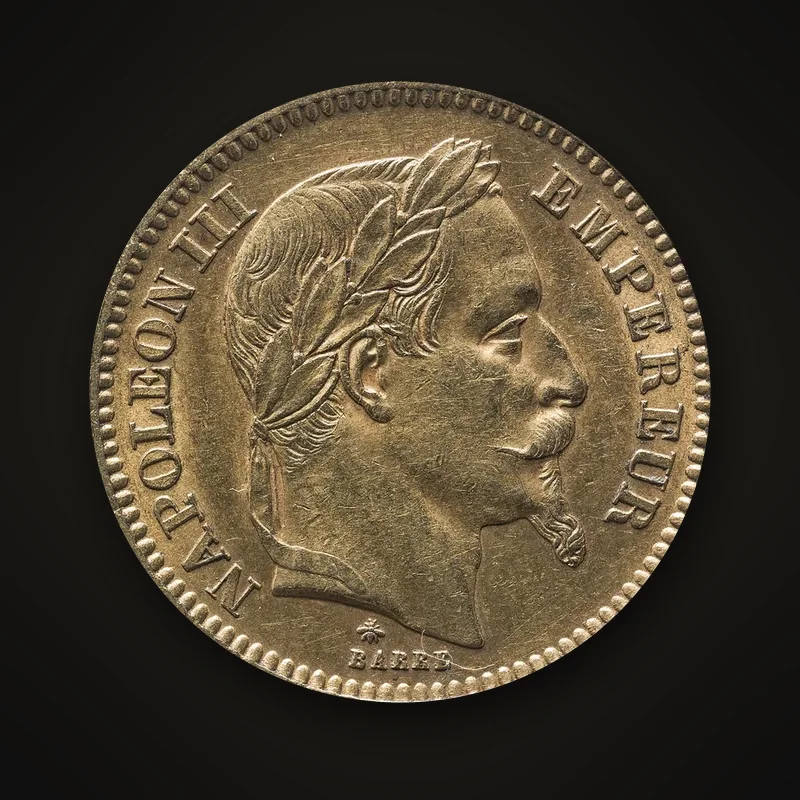
Obverse
Portrait of Napoleon III facing right, bare head from 1853 to 1860, laureate head from 1861 to 1870, signed BARRE below the neck. Legend: “NAPOLEON III EMPEREUR”.
Written by the Maison Or & Bijoux Strasbourg team · updated
| Country | France |
|---|---|
| Metal | Gold, 900‰ fine |
| Weight | 6.45 g |
| Fine gold | 5.806 g |
| Diameter | 21 mm |
| Years struck | 1853-1860 (bare head), 1861-1870 (laureate head) |
| Mints | A (Paris), BB (Strasbourg), D (Lyon, in 1855 only) |
| Total mintage | 146,544,669 (bare head), about 85.5 million (laureate head) |
| References | F.531 (bare head), F.532 (laureate head) |
The 20 francs gold coin of Napoleon III is the “napoléon” in the true sense of the word. Struck from 1853 to 1870 in more than 230 million examples, it turns up very often in estates. Most dates are common; a few dates, a few varieties and coins in very fine condition are sought after by collectors.
Portrait of Napoleon III facing right, bare head from 1853 to 1860, laureate head from 1861 to 1870, signed BARRE below the neck. Legend: “NAPOLEON III EMPEREUR”.
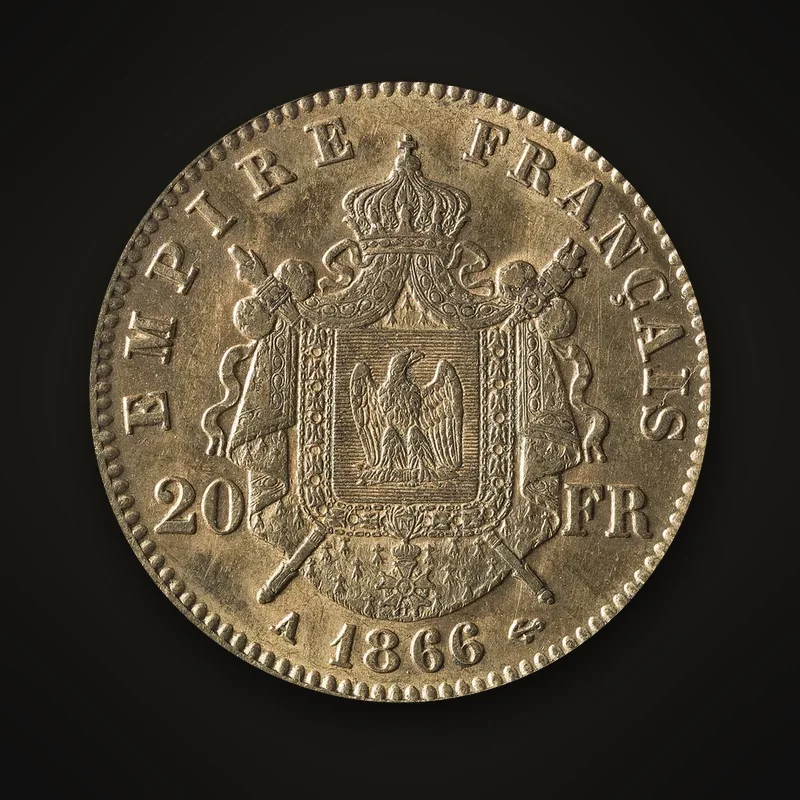
Bare head: “20 FRANCS” and the date within a wreath of two laurel branches, legend “EMPIRE FRANÇAIS”, mint mark below the bow of the wreath. Laureate head: shield with the eagle standing on a thunderbolt, surrounded by the collar of the Legion of Honour, on a crowned mantle; “20 FR” on either side, legend “EMPIRE FRANÇAIS”, mint mark and date at the bottom.
The table gives the most useful year and mint combinations: the largest mintages, which make up most of the coins found, and the smallest. Look first at the mint mark, then at the small symbols on the reverse (the privy marks, or “différents”): for the same date, they are what makes the difference.
| Year | Mint | Mintage | Remarks |
|---|---|---|---|
| 1853 | A | 5,729,471 | First year of the bare head |
| 1854 | A | 23,485,957 | Highest mintage of the type |
| 1855 | A | 16,595,397 | Two combinations of privy marks: dog's head and hand, or hand and anchor |
| 1855 | BB | 1,759,701 | Dog's head and bee, or bee and anchor; the dog's head is the less common |
| 1855 | D | 363,017 | Only year for Lyon, several lion varieties; lowest mintage of the type |
| 1856 | BB | 1,125,030 | Lowest BB mintage of the bare head; dog's head variety sought after |
| 1857 | A | 19,193,214 | No BB striking recorded this year |
| 1858 | BB | 2,016,653 | Figure disputed, see the note |
| 1859 | BB | 5,870,646 | Common |
| 1860 | A | 10,219,917 | Exists with the 6 re-engraved over a 5 |
| 1860 | BB | 5,726,718 | Also exists with 6 over 5 |
| 1861 | A | 2,607,054 | First year of the laureate head |
| 1861 | BB | 1,423,199 | Lowest BB mintage of the laureate head |
| 1862 | A | 4,825,915 | Exists with a “large A” |
| 1864 | BB | 3,323,192 | Small BB and large BB |
| 1865 | A | 2,951,440 | Modest mintage for Paris |
| 1866 | BB | 6,978,507 | One variety with a reeded edge, rare |
| 1867 | A | 2,923,024 | Modest mintage for Paris |
| 1867 | BB | 4,516,490 | Small BB and large BB |
| 1868 | A | 9,281,061 | Highest mintage of the laureate head |
| 1869 | BB | 7,316,553 | Small BB and large BB; figure disputed, see the note |
| 1870 | A | 864,873 | Lowest mintage of the laureate head |
| 1870 | BB | 1,852,567 | Last year of the BB mint for this type |
Mintages from the BDOR and Abacor tables, which agree with each other; the list of varieties follows the Le Franc catalogue (F.531 and F.532). When a year exists in several varieties, the figure covers them all. Numista gives 1,817,394 for 1855 BB, and CGB 2,067,740 for 1858 BB; CGB also attributes 864,873 coins to a variety of 1869 BB. Years missing from the table have intermediate mintages.
The mint mark is on the reverse: below the bow of the wreath on the bare head, at the bottom next to the date on the laureate head. A stands for Paris, BB for the Alsatian mint in Strasbourg, D for Lyon. The great majority of coins come from Paris, and Lyon struck this type only in 1855.
The reverse also carries two tiny symbols, the privy marks (“différents”). One identifies the Chief Engraver, the other the director of the mint. On the bare head, a dog's head refers to Jacques-Jean Barre and an anchor to his son Albert-Désiré, Chief Engraver from 1855. A hand goes with the Paris coins, a bee with those of the BB mint, a lion with those of Lyon.
1855 is therefore a transition year: in Paris as in the BB mint, there is one combination with the dog's head and another with the anchor. The first is the less common. On the laureate head, look at the size of the letter: 1862 exists with a “large A”, and the BB mint has “small BB” and “large BB” in 1864, 1867 and 1869. A ×10 loupe is enough.
The varieties to know: the date 1860 with the 6 re-engraved over a 5, in Paris as in the BB mint; the 1866 BB with a reeded edge, rare; the coins on a burnished flan with a plain edge from 1853 to 1855, made to be given or presented; and finally the patterns of the laureate head, from 1861, 1862 and 1868, which are almost never seen outside collections.
Two families of fakes circulate. The first dates from the Second Empire itself: these are platinum coins imitating dates of both types (for example 1858 A, 1860 BB, 1865 BB or 1867 BB). Their weight can be deceptive; their grey colour shows where the surface is worn or scratched. They are now sought after for their own sake, as witnesses of the period.
The second family gathers modern gold fakes, sometimes of the right fineness, made to imitate a coin in high demand. They can be spotted by soft relief, poorly detailed hair, an edge with badly aligned letters or a weight slightly outside the norm. Always check three things: 6.45 g (a worn coin loses a few hundredths), 21 mm, a crisp raised edge. The guide to spotting a fake coin (in French) details the other checks.
On the bare head, wear first attacks the hair above the ear and on the temple, then the cheekbone and the tip of the goatee. In VF (French grade TTB), the locks remain separate from one another; in F (TB), the hair forms nothing more than a smooth mass. On the reverse, follow the veins of the laurel leaves and the bow of the ribbon.
On the laureate head, the first indicator is the laurel wreath: the veins of the leaves fade quickly, then the leaves themselves merge into the hair. On the reverse, the eagle, the thunderbolt and the links of the Legion of Honour collar are fine and wear before the folds of the mantle.
Most coins found in families are in F (TB) or VF (TTB). An EF (SUP) example keeps its original lustre in the fields, around the letters. Never clean a gold coin: the micro-scratches from rubbing take away most of its collector interest. See the guide to coin grades and why not to clean a coin (both in French).
The name “napoléon” comes from the 20 francs coins struck under Napoleon I, according to the system set by the law of 7 Germinal Year XI (1803): 6.45 g of gold at 900 thousandths. The word stuck for all 20 francs gold coins, whatever the regime.
The Second Empire was proclaimed in December 1852 and the bare head of Napoleon III appeared on coins from 1853. The massive arrival of gold from California and Australia explains the mintages: in Paris, every year from 1854 to 1859 exceeded 16 million coins. From 1861, the portrait was crowned with laurel and the reverse took the imperial arms, to a design by Albert-Désiré Barre.
In 1865, France founded the Latin Monetary Union with Belgium, Italy and Switzerland: their gold coins, of the same weight and fineness, then circulated interchangeably in these countries. Striking of the imperial napoléon stopped with the fall of the Empire after Sedan, in September 1870. The Third Republic then returned to the 20 francs Genius (in French). Napoleon III coins circulated until 1914, hence their frequent wear (see 19th-century coins, in French).
The Strasbourg mint, letter BB, struck a large share of these coins: about 16.5 million bare heads from 1855 to 1860, and nearly 40 million laureate heads from 1861 to 1870, almost half of this second type. Until 1860, its coins carry the bee, the privy mark of Alfred Renouard de Bussière, then director of the mint. The 1870 BB 20 francs is among the last French coins of the mint, before the siege of the city in the summer of 1870 and the annexation of 1871. The 1856 BB and 1861 BB, with the mint's lowest mintages for each type, are the local dates to look at closely; the history of the mint is told on the page Strasbourg coins.
Look at the portrait: the laureate head wears a wreath of leaves in the hair. The reverse also changes: laurel wreath with “20 FRANCS” for the bare head (1853-1860), shield with the eagle on a mantle for the laureate head (1861-1870).
On the reverse. On the bare head, below the bow that ties the two laurel branches; on the laureate head, at the bottom, right next to the date. A means Paris, BB the Alsatian mint in Strasbourg, D Lyon.
The catalogues consulted record none: in 1857, only Paris struck this type. A coin bearing this date and this letter deserves careful examination.
Most dates in ordinary condition are common. Collectors look for 1855 D, the varieties with rare privy marks, the 1866 BB with a reeded edge and coins in EF (SUP) or better. A numismatist can identify these points after seeing the coin, during a free valuation.